OsteoarthritisVatha Soothiram — classical name in Siddha
See all treatment approaches for Osteoarthritis →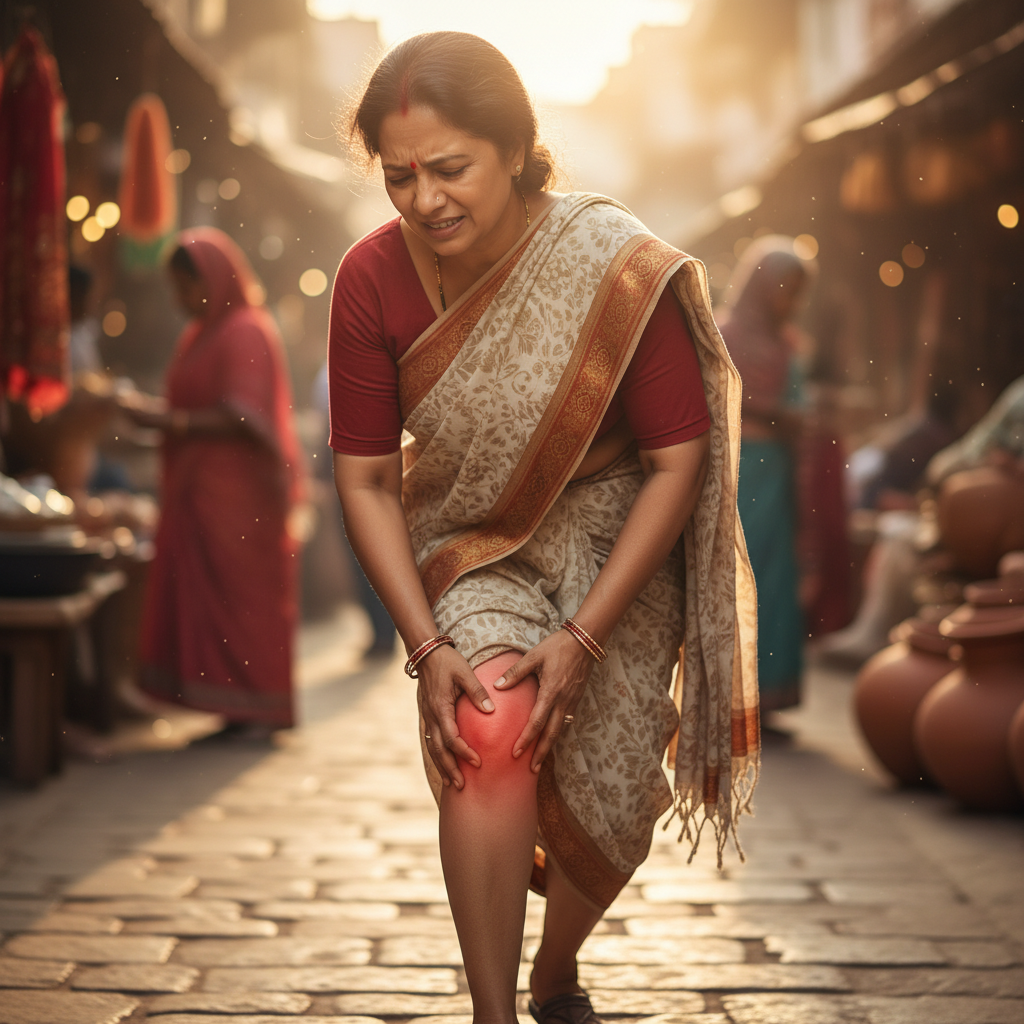
Overview
Osteoarthritis (OA) is a degenerative joint disease primarily affecting the articular cartilage. It is commonly associated with aging and tends to impact joints that experience continuous stress over time, such as the knees, hips, fingers, and lower spine.
In the Siddha system, OA is known as Azhal Keelvayu, which results from the primary vitiation of the Azhal (Pitta) humor. This vitiation is often triggered by consuming foods and engaging in activities that inherently increase Azhal. Consequently, the Vali (Vata) humor becomes imbalanced, leading to the degeneration of joints. This process is characterized by the desiccation effect of Azhal and Vali, causing a drying of the joint's lubricating factors.
The manifestation of Azhal Keelvayu includes symptoms that worsen progressively. Patients may experience grating, clicking, and crackling sounds in their joints, particularly during movement. This condition can also present with pain, swelling, pricking sensations in the joints, restricted movement, muscle weakness, and balance issues, ultimately diminishing the patient's quality of life.
Causes According to Siddha
- 💨 Consumption of foods that induce Vali humor such as tender bananas, potatoes, groundnuts, and foods that dampen the body.
- 🌧️ Exposure to chill weather.
- 🌧️ Getting drenched in rain.
- 🌧️ Staying in mountains.
- 🧬 Genetically inherited predisposition.
- 🔥 Primary vitiation of Azhal humor.
- 💨 Consequent vitiation of Vali humor.
- 🦴 Degeneration of joints due to the desiccation effect of Azhal and Vali.
- 🦴 Drying of lubrication factors.
- 🦴 Wear and tear of the joints related to ageing (Primary OA).
- 🦴 Causes related to congenital conditions (Secondary OA), such as congenital hip dislocation, Legg-Calvé-Perthes disease, slipped femoral epiphysis.
- 🦴 Causes related to trauma (Secondary OA).
Signs & Symptoms Recognised in Siddha
- ✅ Pain in the joints
- ✅ Swelling of the joints
- ✅ Pricking sensation in the joints
- ✅ Clicking of joints
- ✅ Crackling of joints
- ✅ Restriction of movements
- ✅ Muscle weakness
- ✅ Balance issues
- ✅ Degeneration of joints due to the desiccation effect of Azhal and Vali
- ✅ Drying of lubrication factors leading to grating, clicking, and crackling of joints while walking
Herbs & Natural Substances
Therapeutic Approaches in Siddha
Siddha medicine offers a multi-faceted approach to managing Osteoarthritis, focusing on both internal and external therapies. Internal treatments involve a range of formulations such as churnams (powders), parpams (calcinated preparations), chendurams (red sulfide preparations), mathirais (pills), ilagams (syrups), and neys (medicated ghees). These are prescribed to address the underlying imbalances contributing to the condition.
External applications are crucial in Siddha treatment for Osteoarthritis, with Varma Maruthuvam playing a significant role. This specialized therapy involves applying pressure or stimulation to specific vital points on the body. Additionally, various medicated oils are used for external application, and procedures like Kattu (poultice/bandage) and Ottradam (fomentation) using herbal leaves are employed to alleviate pain and inflammation.
Traditional procedural practices are also integral to the Siddha management of Osteoarthritis. These include Suttigai (cauterization) using herbal or metallic methods, and Attai Vidal (leech therapy), where medicated leeches are applied to affected areas. Purgation therapy (Kazhichal Maruthuvam) is also utilized to eliminate vitiated humors from the body, particularly for conditions predominated by Vatha humor.
Dietary Guidance
✓ Favour
- 🌿 Mullangi (Rhaphanus sativus)
- 🌿 Karunai (Amorphophallus paeoniifolius)
- 🌿 Koogai (Maranta arundinacea)
- 🌿 Velladu (Goat)
- 🌿 Kaadai (quail)
- 🌿 Indhuppu (Himalayan rock salt)
- 🌿 Kodam puli (Garcinia cambogia)
- 🌿 Nallennai (Gingelly oil)
- 🌿 Kadalennai (Groundnut oil)
- 🌿 Cow & Goat (Milk & Ghee)
- 🌿 Butter milk
- 🌿 Panai vellam (Palm jaggery)
- 🌿 Naatu sarkarai
- 🌿 Karupatti
✗ Avoid
Lifestyle & Daily Routine
- ✅ The administration of medicine dosage and duration may vary depending upon the patient condition.
- ✅ Patients will be followed up weekly and will be treated up to 6 months depending upon the symptoms.
- ✅ Varmam Maruthuvam should only be done by Siddha Physician.
- ✅ Physician performing Varmam Maruthuvam should be free from sharp nails.
- ✅ Avoid approaching Varmam pressure points with nails & sharp metallic instruments.
- ✅ The better posture of the patient for Varmam Maruthuvam is sitting/lying, so that physician will have the direct contact with patient’s eye.
- ✅ Varmam Maruthuvam can be done twice a week; in case of severity of the disease, treatment can be recommended daily.
- ✅ Based on the severity and condition of the disease, the Siddha physician can prescribe the medicines along with Varmam maruthuvam.
- ✅ Naadi of the patient has to be analysed prior to Varmam maruthuvam.
- ✅ A male physician to male patient and a female physician to a female patient are preferable.
Traditional Preparations
Kazhichal Maruthuvam
Agasthiyar kuzhambu or Meganatha kuligai is taken with ginger juice early morning on an empty stomach. If purgation does not commence, drink hot water. After 5-6 bowel evacuations, consume buttermilk, lemon juice, tea decoction, or fried cumin seeds kudineer. Watery diarrhea indicates successful completion.
Eliminates vitiated humors through the anal route, used for Vali/ Vatham predominant conditions.
Kattu (Compress or Bandage)
The leaves or rhizome are prepared as a paste or poultice for application.
Used externally for Osteoarthritis.
Ottradam (Fomentation)
Leaves are heated and applied as a fomentation to the affected area.
Used externally for Osteoarthritis.
Aavaarai ulunthu Pattru
A paste is made with Aavaarai and Ulunthu, mixed with egg white or drumstick leaves juice.
Used externally for Osteoarthritis.
Suttigai (Cautery cauterization)
Cauterization is performed using Manjal kombu or metal cautery on specific points.
Used as a therapeutic procedure for Osteoarthritis.
Attai Vidal (Leech Therapy)
Medicated leeches are applied to specific locations at designated times over the affected area.
Used as a therapeutic procedure for Osteoarthritis.
Community Experiences
Share your personal experience with Siddha for Osteoarthritis. All experiences are reviewed before being published.
Have you tried Siddha for this condition?
Login to share your experience and help others on their wellness journey.
Login to Share